Tel: +86-181 3837 3963 (Whatsapp, Wechat) | contact@jctmixing.com
Language
Tel: +86-181 3837 3963 (Whatsapp, Wechat) | contact@jctmixing.com
1. Metering system
Precisely control the raw material ratio to ensure reaction stability.
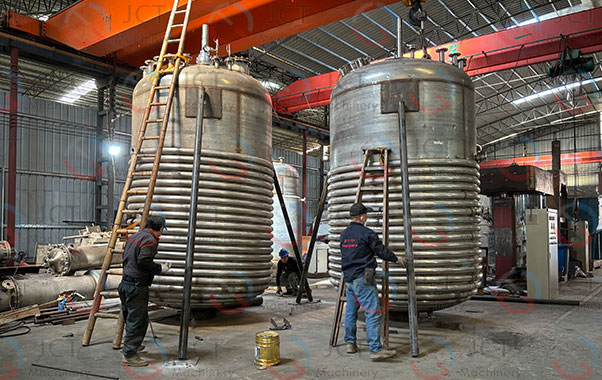
2. Reactor
Carries out polycondensation reaction to produce phenolic resin.
3. Condenser
Condenses the formaldehyde and water vapor released during the reaction for recycling.
4. Vacuum pump
Provides negative pressure during the dehydration phase, accelerating the removal of water and low-molecular-weight volatiles.
5. Cooling system
Rapidly cools the resin to prevent premature curing.
6. Bag filter, vibrating screen
Remove impurities (such as unreacted particles) from the resin.
1. Polycondensation reaction
Phenol and formaldehyde undergo a polycondensation reaction in the presence of a catalyst, producing either linear or bulk polymer resins. The molar ratio of phenol to formaldehyde affects the type and properties of the product. When the molar ratio is greater than or equal to 1, a linear resin is produced; when it is less than 1, a polyhydroxymethyphenol derivative is produced.
2. Dehydration process
After the reaction is complete, dehydration is required. Dehydration can be performed under normal or reduced pressure. The final dehydration temperature is 140-160℃, and the resin molecular weight is 500-900.

We are professional mixing manufacturer, providing sigma mixer, reactor, dual shaft mixer, etc .

